
The political economy of AI — things are getting weird, it seems. We have models on the loose, open weights being dropped from the heavenly temple, and data center protests fanning out across the land. There’s a lot of salience in a way that feels really different than it did even six months ago. To discuss, we have the wonderful Anton Leicht, a fellow at Carnegie and author of the excellent Substack Threading the Needle.
Our conversation covers:
Why even a small amount of AI-driven unemployment could upend national politics, especially if agents start replacing junior white-collar workers and breaking the career pipeline,
What policymakers can do to protect workers without calcifying the economy, how to collect better data on AI and labor, and whether to subsidize junior hiring,
The case for funding the AI transition with corporate income taxes instead of token taxes, and why offering the government AI equity or “golden shares” would backfire,
Data center backlash, strategies for winning hearts and minds, and options for friendshoring AI infrastructure,
The political economy of safety — why pausing AI development wouldn’t work, but a coordinated slowdown might,
The coming reckoning between open source and the national security state.
Plus, Kafka on bureaucracy and happenstance, how Anton’s years in esports shaped his career, and why new ideas seem to travel more easily through American policy discourse than European institutions.
Listen now on your favorite podcast app.
AI at the Ballot Box
Jordan Schneider: Am I right? Are things getting weird?
Anton Leicht: There are several different trends happening all at the same time, and they all seem to be compounding — things are getting real. Parts of the US government are waking up to the cyber implications. There are also a lot of incentives leading into the midterms to find very visible symbols of the things that people on the populist flanks of both sides care about, and it turns out AI is one of them. On top of that, AI is being adopted very quickly. These trends all compound to the point where a lot more newspaper pages and media coverage are full of AI news, and it just feels like it’s all getting very big.
It’s still unclear whether this all comes together into one big “AI is a big thing” story, or whether these are actually three separate stories that will die three separate deaths. But it’s happening.
Jordan Schneider: AI is becoming a national issue that people campaign on and vote on. I remember the 2024 Trump-Biden debate, where one of the things I was watching for — instead of senility — was how much they would talk about AI. Export controls came up once, but it was basically not a thing. It was something on the horizon that people were vaguely aware of.
We can look at all the different streams you mentioned — the labor impact, the stock market, inflation, cyber risk, whatever — and it seems reasonable to assume that at least over the next three months, we’re going to pick up steam, not dial it down. In which case, politicians will want to say they’re going to do something about it. The question then becomes — what?
Anton Leicht: They don’t really know just yet. I wouldn’t be surprised if the midterms were still fairly quiet on this, because a lot of policymakers on both sides are still hiding. They don’t really know, first, which way the wind is blowing, and second, what the specific policy asks should be. They’ll let the midterms happen and let some of the discussion unfold. Then, once they see how salient the issue was in post-midterm polling — once they realize people really cared about this in that race and that race, once they have a view of what the political spending and public opinion looked like — they’ll go into 2027, into the next Congress, realizing they absolutely have to do something. They can’t go into another election cycle having done nothing about this. That’s going to be the sentiment on both sides, and then we’ll be in a window where actual policy that gets real national attention actually happens.
Jordan Schneider: Let’s make this podcast proactive and give people an agenda they can campaign around — or at least use to make the world and our futures a better place.
Anton Leicht: We can start with labor impacts, because that is realistically one of the more salient policy areas. With labor markets specifically, there are two questions. First, are there things that actually need doing? Second, are there things that just need doing for political reasons? There is going to be some political need for action on this — and we’ll have to find the least bad policy that addresses it.
There are things we should substantively do regardless. We should be better at knowing what is actually happening in the labor market as AI affects it. We have very fuzzy, spotty data on this. It’s not very good or comprehensive. A lot of the most important and interesting data sits inside the labs. They have very good statistics on usage and diffusion, and on the gap between how much AI is being used for augmentative purposes versus more automation-heavy workloads. That is all extremely useful data for making any kind of responsive policy, but we don’t really have it — only the labs do. Finding some way for governments to access this data and make decisions based on it seems obviously valuable. Then there’s the separate question of actually dealing with the labor market impacts.
Jordan Schneider: Let’s start with statistics. This is classic ChinaTalk — three minutes in and we’re already on the Bureau of Labor Statistics (BLS), which has been beaten up fairly embarrassingly over the past year and a half. The cadence is slow, and the tools aren’t tuned to answer these questions. When you look at the productivity data, it doesn’t tell you anything like “Opus 5 is doing more than Opus 4.8, so we should have some labor intervention.” Your point stands — having a tactile feel for what people are actually using their API calls for is at least as relevant as lagging indicators like who’s getting hired and who’s getting fired.
Anton Leicht: Definitely — data from API calls is simply less lagging. You get a sense of whether these workloads are structured so that they take on an entire task profile analogous to what people currently do as a job, or whether usage is extremely spiky, with all the workload going toward very specific tasks. In the latter case, you could imagine the labor market reorganizing around the tasks being carried out by AI systems, with people filling in the gaps in the jagged frontier and doing the things AI isn’t good at. The alternative would be agents being deployed as full-stack replacements for the workers’ task profiles.
There’s a bunch of data along these lines that gives you some idea of what more adoption would even mean. If governments and policymakers choose to hasten adoption right now, would that push us toward a more competitive workforce that is better augmented by AI tools? Or would hastening adoption mean outright displacement? We just don’t know.
Depending on how these questions shake out, there are very different policy imperatives for dealing with possible labor market impacts. If the workloads are augmentation-heavy, you want to hasten adoption now, because you want to make the workforce resilient and as productive as possible so it doesn’t get shocked into much higher unemployment later, when other competitors have become more competitive. But if adoption right now already leads to high amounts of automation and displacement, then policymakers might have some motivation to slow things down a little.
We have only spotty data on this from some of the labs. If you look at Anthropic’s Economic Index, they have good information — sometimes they volunteer it, sometimes they share it with internal researchers, sometimes with external researchers. But that’s data from one lab. It’s not standardized with data from other labs, and we don’t really know whether Anthropic’s consumer base skews in a particular direction. We need to find a better way to aggregate this data and make determinations based on a larger share of the actual AI usage market. We’re very far from that.
Jordan Schneider: Even when you try to break it down — is this just making workers more productive, or is it drop-in replacement? — the answer is going to be both. Even if it’s a drop-in replacement, that doesn’t necessarily mean everyone will lose their job. There are second and third layers of analysis, and then you have to price in what happens if these models are much better in six months and what that means. With all those caveats, data is good — we’re fans of more data here. What tools do you think smart legislators should be putting on the table?
Anton Leicht: What can we actually do about the labor market impacts once they arrive? The question is what you want to achieve. There are plenty of tools that respond to the immediate political need of avoiding widespread displacement. If you talk to very AI-pilled people, they will tell you about headline unemployment numbers north of 10 or 20 percent. In political terms, that is a crazy world to be in. I don’t think there has ever been a functioning Western democracy with 10 or 20 percent unemployment without things actually going to hell. These are crazy numbers, and if we’re in that world, this isn’t even a prospect policymakers would seriously entertain.
But there’s a scenario one step below that — say we get an uptick of 1 percent unemployment. That is something we might realistically expect during a transition phase, even one leading toward a much more productive and much better economy. We have definitely seen upticks into high single-digit unemployment in the wake of technological transformations. In some ways, that’s a good trend, because it means people will potentially end up in better jobs, the economy gets more productive, and we get better growth. There are all these high-level macroeconomic reasons why you might welcome this kind of trend and say that some intermittent higher unemployment is a feature, not a bug — a necessary step of creative destruction on the way to that better economy.
That’s obviously politically unsustainable, though. We’re not going to have two or three years of 8 or 9 percent unemployment where people say, “Creative destruction sounds great to me — I’m very optimistic about the shape of the future economy once this all settles down.” You need some way to smooth over the disruption enough that you can still reach this better equilibrium without the displaced revolting and without the political economy going completely off the rails. That’s a very different question from asking whether we want to stop this altogether.
If we stay with the question of how to smooth this over, most of it comes down to compensating the specific losers of this transition. That’s really hard, because in past technological disruptions, what we’ve mostly tried to do is take, say, the 55-year-old displaced steelworkers and give them wage insurance or early retirement. It didn’t go perfectly, but there is something you can do about having someone retire ten years earlier. Purely financial compensation works reasonably well at stabilizing their situation and giving them the sense that, while this is unfortunate, it’s not an existentially terrible situation. You can’t do the same thing when the entire pipeline of ambitious young white-collar workers breaks down.
The Political Tipping Point for AI Displacement
Jordan Schneider: When does unemployment become politically salient? For all the talk of AI taking jobs, US unemployment is pretty low — and it’s been low for long enough that a spike will be a big shock to the system and will freak people out. I agree with you that it won’t take 10% unemployment to alarm people.
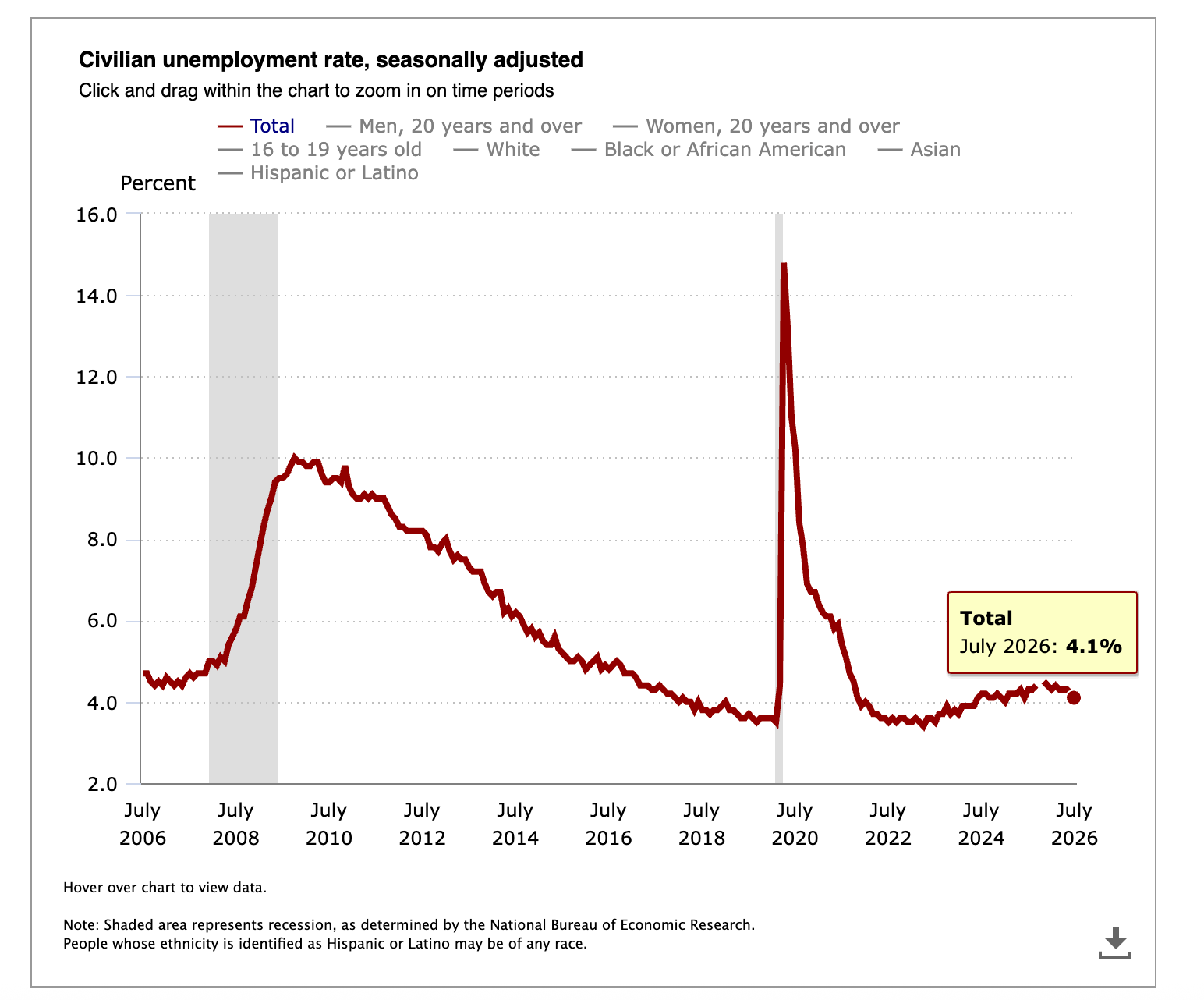
You don’t even necessarily need a big absolute spike. You just need one interest group, one industry, or one geography to get hit really quickly, and suddenly it’s front-page news. Everybody knows an accountant — everyone has an accountant in their life. There’s no world in which the political class or democracies tolerate 10 to 20% unemployment. You asked which democracies could be fine with that. Well — Europe, kind of, for a decade.
Anton Leicht: But that was tough. It wasn’t a very stable political situation either.
Jordan Schneider: It was also multicausal, and it was a bit of frog-boiling — everyone thought it was going to get better. There was one shock, and it just dragged on for a while. These seem like very unanalogous situations, where it will only take a little bit of targeted unemployment to freak people out.
Anton Leicht: It can be really targeted, because the political incentives for exploiting this come back to the question of political salience. There are a lot of general political messages that are extremely compatible with making a big deal out of AI unemployment once we see any trace of it. There’s the entire story about tech oligarchs building huge data centers, using all this capital to build systems that displace workers and take away their dignity, livelihood, and prospects. There’s the tension between coastal elites and the rest of the country. There’s the story of tech CEOs aligning with the administration. There are so many political incentives to amplify any small instance of labor disruption that I see basically no way this doesn’t become a big, salient issue. It just needs to happen somewhere.
We’re already seeing layoffs being blamed on AI that aren’t even substantively about AI, just because it makes for a convenient story for the firms doing the laying off. We’ll see more of that. We’ll see junior hiring freezes in some domains as people start experimenting with using agents instead. We’ll see, as always happens, some companies going under and blaming it on AI and new technology. Then 20,000 people will be out of work, and the story will be about how AI suddenly wiped out 20,000 jobs somewhere, followed by big media coverage.
The particularly tricky part about AI displacement specifically is that it hits junior white-collar workers. There’s a limited extent to which the rest of the country really empathizes with displaced 55- or 60-year-old steelworkers. But there’s a much broader sense in which many people have children, or know people who want to build a better life for themselves. There’s an American-dream quality to the idea that you can study hard, work hard, and make your way into an ambitious white-collar job — that there’s a career trajectory, a channel for ambition, and a path to a better life.
If that pipeline breaks and a story emerges about widespread youth unemployment and the hopes and dreams of the younger generation being dashed, that’s an even more explosive political story, because so many people will be able to empathize with it. It doesn’t take much for this to blow up — just a few very localized instances.

Protecting the Entry-Level Job Market
Jordan Schneider: Here’s the thing — fake concerns like the water use controversy have already blown up. Fear of data centers as an abstract phenomenon is something I would not have priced in four or five years ago. The fact that this is all just latent noise driving the backlash, as opposed to some acute event, has been remarkable.
We’ll come back to data centers, though. I want to pick up on your point about college grads who can’t find jobs. The one place where the entire society has already been impacted is with middle schoolers, high schoolers, and college graduates, where suddenly the schooling experience has changed. As a parent, you’re stressed out and concerned — abstractly about the job prospect question, depending on how old your kid is, but also very acutely, because homework that used to be homework is now just something ChatGPT can write. That anxiety has already been building. To have it then manifest as, “Okay, I’m 22 and I can’t find a job,” is a very salient, anxiety-producing thing.
Anton Leicht: It is, and it’s just very unclear what we’re supposed to do about it. There’s a real sense in which junior workers don’t add that much — they don’t do that much good work. The general logic is that they do some of the more menial, repetitive tasks — tasks that AI agents are genuinely very good at — and firms hire them as an investment in broader talent pipelines. They keep them around, and a few years later, they’re useful.
But the basic math of hiring junior white-collar workers still has to hold. They need to bring something to the table so it’s worth it for a firm to hire them at all. Otherwise, it’s just too economically enticing to cut costs, skip the hiring, and hope that someone else will hire and train entry-level workers instead.
There might even be a world where this isn’t actually rational in terms of company incentives, because firms lose out by failing to build the pipeline into mid-level positions — the five-to-eight-years-of-experience positions they will really need to fill in the future, especially once there’s more and more AI agent capability to be orchestrated by that middle layer. But they may not build these pipelines, because their short-term incentive is to skip the junior hiring — “Well, we can just use the agents for that instead. We can save this entire hiring round.”
There’s a real concern that this is simply a coordination failure across the economy. Everyone has short-term incentives to skip junior hiring for a year or two, and then we suddenly lose out on educating and building out an entire generation of junior white-collar workers who can’t find jobs. They never turn into those experienced five-to-eight-year workers who could sit above the agents and do the orchestration and augmentative work.
Jordan Schneider: Is your proposal, then, to subsidize the 22-to-27-year-olds — by changing the tax code or something — so they’re less expensive to hire?
Anton Leicht: It’s tentatively the least bad version of fixing this problem that we might be able to come up with. There are still things about it that I don’t particularly love, because the baseline concern is that we don’t want to calcify current economic structures too much. Every subsidy, wage guarantee, and jobs guarantee carries the risk of brute-force subsidizing a very specific economic structure — one that works at one level of technological deployment but doesn’t work at the next. We might want the economy to transition naturally to having very different jobs for junior workers, or perhaps a very different concept of what it means to be a junior worker — when people start doing productive work, and what education looks like before that. We want to leave room for that.
Jordan Schneider: As a veteran of the German political ecosystem, can you draw the comparison? What’s the failure case American politicians should be trying to avoid?
Anton Leicht: The failure case is that we completely locked down the labor market. We made it massively calcified by giving everyone extremely strong labor protections, which means they basically can’t be fired. That in turn means there’s a very high bar to hiring anyone, because once you hire them, you can’t really let them go. It becomes very hard to start new speculative firms, because once those firms start struggling, they can’t actually lay off the people they’ve hired. They’re structurally disincentivized from being particularly ambitious and hiring quickly. It becomes difficult to reallocate talent within your economy to new areas of business and commerce that might emerge as the economy expands around what’s now possible — say, now that there are a lot of very intelligent AI systems. You’re just stuck with the specific economic structure you had when you started handing out all these labor protections.
That works well if the economy is moving slowly — if what you’re doing is iterating on a well-established paradigm. In the German case, we build cars, and we gave strong labor protections to everyone involved in building cars. Those workers are very secure and very safe, and they keep iterating on building marginally better cars. There are basically no new firms — nearly all the economically important firms in Germany are almost 100 years old. There aren’t many dynamic new entrants. That works in a low-technological-pace, high-marginal-iteration environment.
But then technological disruption comes along. Now we’re doing EVs instead of the legacy car industry, or it might be good to pivot the industrial base toward defense production. That turns out to be very, very difficult if the labor market is too calcified. You get a competitiveness problem later on, and at that point the labor protections don’t help anymore either, because the firms are simply no longer competitive. They don’t sell any cars because the EVs are better and cheaper. The firms go under, and everyone gets fired anyway, because the firm is just no longer there. You don’t actually get the protection in the long run.
That’s the failure mode you want to avoid — but you also want to avoid the failure mode where no one has work because everyone is scared of hiring, thinking they can cut corners and save. That’s where the subsidy idea comes in.
Jordan Schneider: The idea that 22-to-27-year-olds are the people we need to protect is interesting, but why not just subsidize humans? Why don’t we cut payroll taxes or something to give humans a better shot relative to AI?
Anton Leicht: We should also do that. We should at least even out the tax incentives. There’s a miscalibration in the fact that if spending on AI agents and AI tokens directly competes with hiring, the structure of the tax system means that CapEx on AI buildout — and maybe even agent spend — is much more favored by the tax code than hiring humans and paying payroll tax for them. That seems like a concerning asymmetry, and it should be fixed — not necessarily to actively boost humans over AI systems, but just to make it not irrational to hire a human for the same thing that a million tokens could do.
The junior hiring problem is something we should be more concerned about ahead of time, because of this pipeline-breakdown effect. You don’t only get the incidental youth unemployment — you lose the talent development that would enable those workers to do better jobs later.
If you increase unemployment by one or two percent across the board because everything is getting more efficient, more people are getting laid off, and there’s creative destruction, that’s not great — and we’ll probably find political responses as it happens. But that’s an economy-wide effect that requires complex handling at an economy-wide level. There isn’t really anything you can do about it surgically. It’s going to be a broad-based economic and political trend that’s very hard to get ahead of.
It is slightly easier, however, to get ahead of this very narrow, specific failure mode. First, these systems seem uniquely, specifically good at doing junior white-collar jobs. Second, there seems to be a strong incentive — and it seems uniquely easy — for firms to skip junior hiring rounds specifically, as opposed to laying off people with more experience, just on the hunch that AI agents might come in. Third, there are long-run consequences of losing out on this generation’s talent development for a few years. Those are features that make this problem distinct.
Jordan Schneider: But don’t we want them all to turn into plumbers anyway? Aren’t we slowing our plumber-nurse-schoolteacher transition?
Anton Leicht: I’m not sure how many jobs the plumber-nurse-schoolteacher-data-center-electrician transition can really absorb in the long run. That’s a big bet. Qualitatively, it sounds great. Quantitatively, I’m not sure the numbers actually work out. At some point you’ll have built the data centers and most of the infrastructure, and I’m not sure the math on that really works.
Jordan Schneider: But by doing this, we’re taking another bet — that there will be white-collar jobs in the future that we want to exist, right?
Anton Leicht: It might be a bridge to nowhere in some sense. You start subsidizing, and then once the subsidy runs out, workers don’t get hired because it turns out you don’t need them anymore. The layoffs start creeping up the job ladder until they reach more and more experienced workers. That’s possible — but in that case, we have bigger problems anyway.
In that scenario, we’ll have very widespread unemployment, well into the double digits. We’ll see the kind of broad displacement that some of the more jobs-doomer types predict, and then we’ll need an on-ramp into actual broad-based redistribution. Having figured out a comprehensive subsidy system that keeps jobs around as a vehicle for delivering what is basically redistribution isn’t the worst infrastructure to set up ahead of time, if that’s the future we’re heading for.
If you ask smart people who do a lot of polling and thinking about the best way to deal with a world where white-collar jobs actually don’t make sense to pay for anymore, not all of them will say it’s just going to be UBI and handouts. A lot of them will say it has to be something like a jobs guarantee, where you wrap the redistribution into some version of a task that is at least marginally useful. You can imagine a world where a marginal job subsidy gets increased and increased until it starts resembling a jobs guarantee- based redistribution scheme. Building the infrastructure for that through a junior hiring subsidy is not the worst on-ramp to that endgame, if that’s where we’re heading. I still hope it’s not, and I still think it’s not — but if it is, I don’t think we’ll regret having spent time building that infrastructure.
Jordan Schneider: The other parallel to subsidizing young white-collar workers is the question of guild protectionism. We talked earlier about how some group is going to be hit hard and fast at some point. Is this a model for that? Because that seems like a failure mode to me — creating some protection for the accountants or whoever it happens to be.
Automation, Lobbying, and the Race for Legal Protection
Anton Leicht: We’ll see almost a race to the bottom on this. Many domains and job profiles are going to make the case that they specifically shouldn’t be displaced by AI. Some professions will end up with fairly arbitrary human-in-the-loop laws. In some professions, we might substantively have a preference for humans carrying them out. Then there are jobs with a sufficiently strong lobby that accounting simply has to be done by a human, or lawyer tasks have to be done by a human — and then that expands to a bunch of other domains. Many jobs and professions will lobby for these specific carve-outs from automation, essentially by asking for legal protections.
It will be hard to sustain that, though, because at some point you get vertically integrated competitors that don’t offer exactly the same kind of service. There will be vertically integrated, essentially AI-only firms providing not quite legal advice, but almost legal advice. There will be a lot of lobbying to keep those out of the market and to ban them — but then there will be open-source versions.
As soon as capabilities exist that can do similar things to what these professionals — accountants, lawyers, whatever — do, it will be very difficult to keep people from using this abundant capability that will be available somewhere. It will be hard to keep them from paying for it. Yes, you can protect employment in the legacy pathways through which these jobs and professions are carried out, but in practice, people will find shortcuts. There will be vertically integrated competitors. In the long run, I just don’t see how it works out if this kind of intelligence is sufficiently abundant.
Jordan Schneider: Speaking of vertically integrated competitors — my wife, for whom I sent out the newsletter seeking a co-founder, has now found one. They are looking for partners, investors, and advisors, as well as potential hires, to take on the incredibly inefficient commercial insurance broker ecosystem.
Anton Leicht: There you go. Many such cases.
Jordan Schneider: Reach out — jordan@chinatalk.media. We’ll put you in touch if you want to be a part of that.
Anton Leicht: If you want to accelerate the atrophying of the legacy.
Jordan Schneider: Your take, then, is that whatever these protections turn out to be, they won’t truly stand in the way of productivity growth?
Anton Leicht: They’ll delay things, and there will be enough risk-averse people who still go with the legacy firms. But if it’s inefficient to keep humans in the loop, these firms will operate at a massive price disadvantage in providing whatever services they offer. Yes, there are a few select examples of highly protected, guild-like structures. But in the long run, the efficiency gains will be so brutal that the next best outside service will win out.
Jordan Schneider: The way this story happens is that the underlying thing gets banned, right? The underlying thing that’s ten times more productive gets banned — not just that you have some protection scheme.
Anton Leicht: You start with the protection, but then you need the lobby to actually stop the alternatives that are popping up everywhere as well. It’s not enough to have the law on the books that says only humans can be lawyers. You also need to crack down on every application of a chatbot that says, “Well, this is not legal advice, but if it were legal advice, I would caution you against doing this and advise you to do that. If you want to go to court yourself, you might want to say these things — but again, this is not legal advice.” You have to stop the models from saying that, and then you have to stop the clever prompts from extracting the same information from the models.
Jordan Schneider: Then you have to stop the open-source models.
Anton Leicht: Right — good luck. At some point, this is just not going to work. The accounting case is the same. You would have to stop the models from being able to process your Excel sheet. At some level of abundance, it’s simply not going to work.
Optimal Taxes and the Trap of Golden Shares
Jordan Schneider: Your other suggestion is raising the corporate income tax. Setting aside Ireland and everything else — why do you like that intervention?
Anton Leicht: We shouldn’t raise the corporate income tax just because I’d like to raise it. The underlying problem is this: if we expect some of the revenue from taxing labor to go away because there’s going to be disruption to the labor market, then it follows that we need the money from somewhere else — especially if we think we need to pay for things like junior job subsidies, or whatever your favorite intervention is. It doesn’t even need to be that. It can be job guarantees, or retraining programs if you think that’s a good idea. Those are also expensive. No matter how this shakes out, if there is going to be some amount of labor disruption, we’re going to need money to pay for the response, and we currently don’t have it. As one leg of this, we’ll have to find some taxation structure that gets us the revenue to pay for whatever we might want to do.
There are a lot of bad ideas about how to do that. The default case for corporate income tax is that it’s a system that already exists. It’s reasonably non-distortionary compared to more targeted taxes, and it’s reasonably effective at capturing value wherever it accrues. It’s agnostic about whether the model developers are the ones who make all the money, or the chip designers, or the adopters. There’s even some initial precedent for getting an international version of this to work. The G20 minimum-floor arrangement didn’t actually happen, but it got pretty far along, and it’s not absurd to think we might get something like it done if AI makes the issue much more pressing. It’s something we have, something that works fairly well, and something we know doesn’t actively backfire. That’s a test that basically no other idea passes.
You could instead do asymmetric taxation of AI specifically. One idea people have been talking about a lot — the Steyer campaign and the Bores campaign have both raised it, for example — is a token tax. The more AI tokens you draw, the more you get taxed. The problem is that it hits the ambitious adopters the hardest and the legacy firms that do the least adopting the least. It’s not clear that’s what you want if you’re worried about AI labor disruption, because what you care about is the ratio within firms. You have a firm with a bunch of human employees, and what you don’t want is for them to reduce the human headcount and increase token spend instead.
Anton Leicht: You’d be very happy if firms kept all their employees while also spending heavily on tokens to augment those workers — keeping people employed, making the firm much more competitive, and ensuring it isn’t as susceptible to disruption from more AI-integrated firms in the future. As long as a token tax only cares about how much you spend on AI, it actively disincentivizes firms from moving toward this augmented, adoption-forward posture. Instead, it incentivizes them to pursue the protectionist interventions you’ve talked about, or to simply hang on for as long as possible and eventually go under in five years because they’ve become uncompetitive. There are a bunch of misaligned incentives in AI-specific taxes.
There are several other proposals along these lines with similar features. The unifying theme is that whenever you try to target AI specifically, you also hit augmentative uses of AI that might be very valuable in staving off the worst version of the labor market impacts. That’s the category we have to trade off against — and in that comparison, the corporate income tax wins.
Jordan Schneider: The corporate income tax is tricky, though, because you generally tax things you want to disincentivize, and companies growing isn’t like cigarettes. But I take your point if we’re comparing it to the alternative — say, taking a 10% stake in OpenAI.
Anton Leicht: What we’re currently taxing — what we’re trying to replace — is labor, and we also don’t want to disincentivize people from working. We’re already taxing a desirable activity purely for revenue reasons, so on that trade-off, we’re fine.
If the alternative is the stake, that seems like a horrible idea. There are two versions of the stake proposal — a few different axes here —, but the first question is whether the government takes stakes specifically in AI developers or in a broad portfolio of AI-related firms. If it’s only the AI developers, you have a regulatory capture problem. If your tax revenue — or the number showing up in your Trump accounts, or whatever — depends not on the economy doing well, but on a very specific subset of the economy doing well, namely these AI developers, you create very specific incentives in how you make AI policy. You want the revenue accretion and value capture to happen at the level of the AI developers specifically, so you don’t want it happening at the level of the infrastructure or at the level of the adopters. Think of the “little tech” joint letters, right? This is exactly the kind of regulatory capture people have actually been worried about over the last few years. If there’s a specific fiscal incentive for the government to ensure that OpenAI and Anthropic capture the revenue and no one else can, that seems obviously horrible.
Jordan Schneider: It’s already strange enough for a president to be indexed on how the stock market performs. I’d much rather have that than a president indexed on this little Trump account thing — a basket of four companies from a single sector.
Anton Leicht: What you might say then is, “Well, then we do the better version of the stake — we get a fairly diversified portfolio, stakes in all kinds of AI companies.” But a lot of the startups, a lot of the swift adopters, aren’t actually listed in any way. You won’t actually have the Trump accounts guys running around writing angel checks in Silicon Valley. That’s probably not going to work.
Jordan Schneider: I’m not sure the Schneider household insurance broker’s competitor is quite open to the economic defense Deal Team 6 coming in for a 5% stake.
Anton Leicht: That probably doesn’t work. If you diversify enough — if your measure for what goes into the stake is “we’d like a diverse spread of firms that might plausibly benefit from advanced AI systems diffusing into the economy” — then in the limit, surely that’s just the stock market. We don’t actually know all that much about where the value goes. You end up with an imperfect simulacrum, a proxy of the stock market that you rebuild in your Trump account and call an AI stake.
It has chip designers. It has a bunch of services firms that have deals with AI labs. It has the AI labs themselves. It has pharmaceutical firms that might benefit from AI R&D, and manufacturing firms that might benefit from industrial iteration. At some point, you’ve just recreated the stock market from first principles and taken a stake in all of it.
In the limit, this collapses to one of two things. Either it’s a stupid sovereign wealth fund set up ad hoc, without sufficient investment structures and investment targets that actually work to give you long-run access to capital. Or it’s a galaxy-brained recreation of the corporate income tax that we’ve been talking about anyway, because it captures value created by all companies. We might as well just do that.
Data Centers and Self-Inflicted Backlash
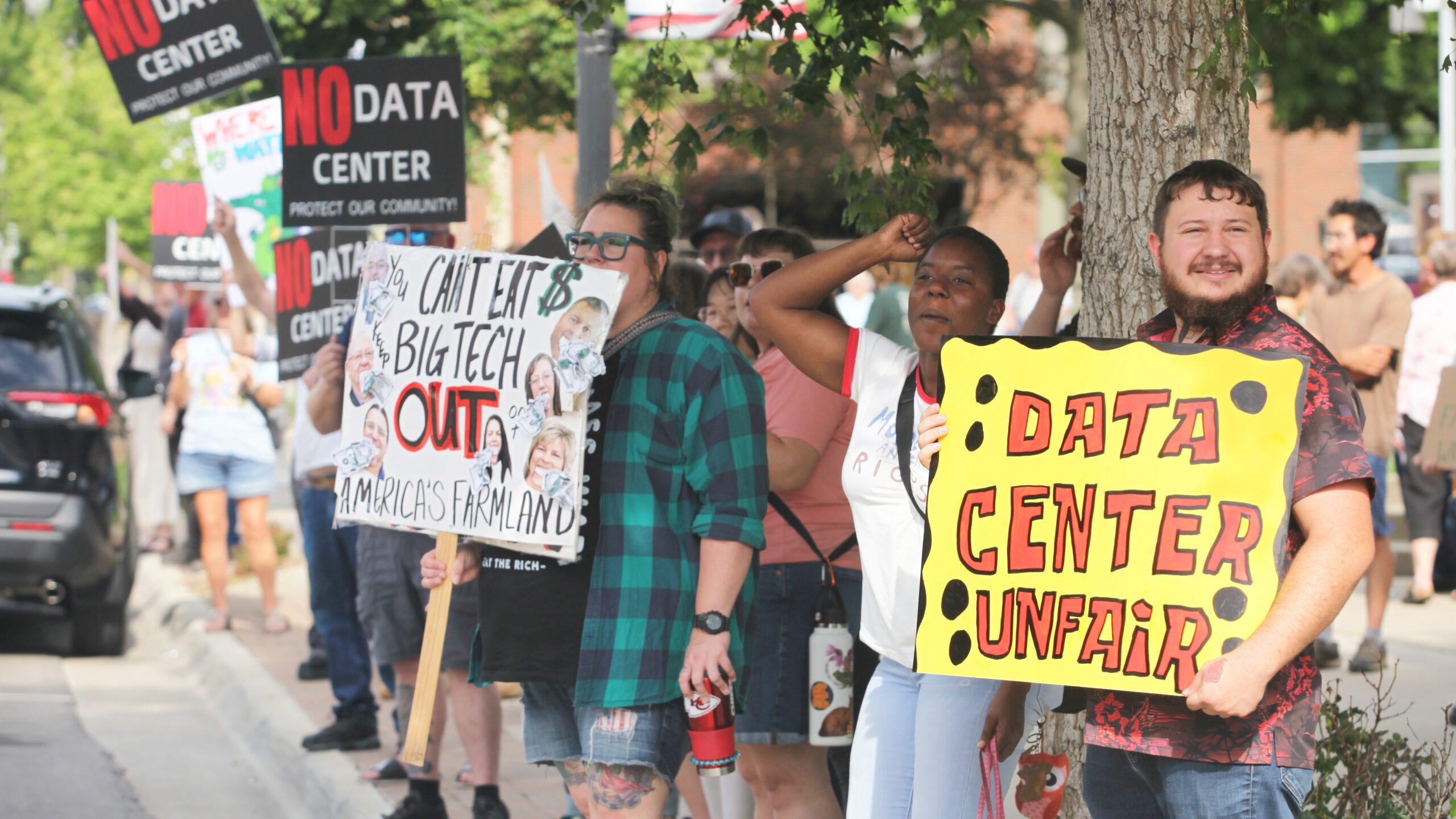
Jordan Schneider: Let’s talk about data centers. My premise is that this is the companies’ fault. There is so much money in keeping this train going that spending the extra $100 million to make a data center quiet, the extra $100 million to make it pretty, the extra $100 million to put pickleball on top of it so it’s a fun place to be — so that you actually want it in your neighborhood — makes the current situation an incredible series of own goals on the part of this entire ecosystem.
The fact that you see folks blaming the backlash on Chinese propaganda is embarrassing and incredible cope. Shout out to the Chinese for tweeting four things, but that is not where this is coming from. You’ve started to see a little movement — they’re promising your electricity bill won’t go up — but where do you think this leads, and what’s the right response?
Anton Leicht: There are always these stories about how a neighboring city is building a lot of data centers, and incidentally, their new high school also looks pretty nice. On the local level, the deals look pretty favorable to some of these communities. The recently announced OpenAI data center in Georgia comes with a lot of very specific investment in the local communities where the data center is located.
Jordan Schneider: There was one in Michigan where the community got its rec center upgraded. And that was it. You could 10x this stuff, you could 100x this stuff, and these are rounding errors of rounding errors.

Anton Leicht: You say that, but at some point people also have some version of an immune response to massive investment by external firms into their community. You can’t just buy people 100 pickleball courts and expect them to say, “This is great. We just love the fact that these Silicon Valley firms are coming in and spending all this money.”
Jordan Schneider: Fine, maybe not pickleball — maybe it’s data center UBI. All you need is one town, right? You can just ask, “Who wants $20,000 a year for the next 10 years for every household?”
Anton Leicht: On principle, I’m completely with you. The hyperlocal resistance you can probably buy off in a bunch of ways, and that’s probably the way to deal with it. It’s not even malicious — you just let the towns compete for who wants the subsidy.
It’s not quite as easy, though, because not every town can host these facilities. There’s a limited selection, and companies really want the sites with the grid connectors and fast time to power. You can’t actually do it everywhere, so it’s not a clean race to the bottom in the same way it is for corporate local taxes or whatever. But yes, you can do that — that works for the hyperlocal resistance.
I’m not entirely sure it works for the state or federal level resistance. Federal-level resistance is just big-ticket politics. State-level resistance is in a weird spot in the middle — it’s salient and local enough because it’s about something being built in the state. State policymakers have a physical anchor for the things they’re talking about, and it connects to the big federal conversations because it’s about money, foreign influence, and things coming in and being built against the democratic better judgment of the community. That makes a very compelling story on the state level specifically.
Jordan Schneider: It’s an interesting inversion, because generally you have governors and statehouses handing out tax subsidies to bring in investment. No one is screaming all that much about whatever factory shows up in town. This is sensitive not because of the buildings themselves, but because of what they represent.
Anton Leicht: I would be curious to see to what extent that is the case. There was also backlash about Amazon logistics centers being built. Some of the rhetoric is simply, “People are building big things in my neighborhood, and I don’t like them very much.” That’s one part of it.
The other part is people projecting their general concerns — not only about AI itself, but also about the things AI represents to them, like the strange ways tech is changing their lives. They’re projecting that onto the data centers.
There’s also a sense of people being disturbed by the sheer amount of money and the scale of these projects. There’s a fundamental suspicion — so much money is coming in, they’re promising all these really big things, and the facility takes up a third of our town. It’s this huge deal.
Jordan Schneider: But that doesn’t happen for a car plant, right?
Anton Leicht: Because people have rich context on what a car plant is, what it’s used for, and why it’s valuable. They have experience with the fact that it brings jobs. But maybe this also has to do with the speed at which data centers are coming up all across the country. There was never a time when this many car plants got built. If we had a huge boom where dozens of gigawatts of car manufacturing went online all over the country, I’m not entirely sure we wouldn’t also get a similar level of backlash. It’s just going very fast.
It’s a really big thing moving very quickly, and there’s always going to be a homeostatic friction effect that pulls against that to some extent.
Obviously, it’s going to be very hard to build here, which is why people are thinking about where else one could build — somewhere outside the US.
Jordan Schneider: What’s the national power net assessment if the data centers get built in Alberta and Guadalajara?
Anton Leicht: It depends on where exactly you build them. If you build them in allied countries where you have favorable access deals, you actually get to pull in those countries — maybe even get these allies to provide some amount of fiscal backstop or fast-track the permitting. That works pretty well because you reduce some of the political backlash risks, you diffuse some of the political costs, you diffuse some of the capital costs, and you just get better sites.
We don’t have that many sites left in the US that have very fast time to power. We’re running out of behind-the-meter turbines very fast. We’re running out of stable grid connections for quick-to-build data centers pretty quickly. There’s been media reporting on the build-out in Australia, for example — it turns out we can build a few gigawatts of data center capacity in Australia pretty quickly. If the Australians are good with that, and if they like the things that come with the deal — the actual physical investment, maybe something on security integration and favorable access to the frontier models — that seems pretty good for both sides.
It gets less good when, A, you plan to screw over these allies at some point in the future, because then they might decide they want to use their data centers as leverage to stop you from screwing them over. If you’re going to pass eleventh-hour export controls, if you’re going to come up with non-transparent access schemes, they will be incentivized to say, “Well, you can do this, but then you can’t use the GPUs you have on our shores anymore.” To the extent that you’re planning to do that, it’s not great to have them anywhere else.
It also gets more difficult if you put them in countries that are more susceptible to being bombed by a lot of drones, or hosted by countries that might give incidental, complicated access to China. You have to be careful about how good your bilateral relationship is, how high your willingness is to give actual access and treat fairly with these allies, and you also need to be careful about not putting them in very volatile locations or countries that might not have your best interests at heart. But if you put them somewhere like Australia, it’s done.
Jordan Schneider: It’s funny — there’s an understanding that rare earth production is dirty. But these data centers just buzz a little bit, and if you spend money, they will stop buzzing. Maybe there’s a gas turbine in one, but that’s also a fixable thing over a six-to-twelve-month horizon. To open yourself up to all of these second-order naughty questions in 2029 just because you’re cranky is a bit of a bummer.
Anton Leicht: From a global perspective, it sounds like pretty good news for the world that you can’t actually concentrate all this capacity on the shores of one country.
This is actually rather nice — we can diversify the leverage over this incredibly world-changing technology across the allied world, and then we’ll have some grounding for building an alliance structure that can last a little longer. I feel good about that, but I understand that from the narrow US perspective, the alternative is simply to put all of them in Abilene and be fine with that.
AI Safety vs Political Inertia
Jordan Schneider: We’ll have you back for a middle power show. Let’s talk safety for a second. Where do you see the political economy of safety showing up?
Anton Leicht: I’m skeptical that this is going to be a big-ticket political issue, because it’s structurally very difficult to come up with ways in which AI safety issues — those catastrophic risk issues — become salient. Cyber still feels pretty abstract to me. There is no obvious pathway to a seriously salient but non-catastrophic warning shot on biological misuse. Most of the really scary loss-of-control scenarios that would actually shake people into action are going to be so catastrophic that we should do safety policy before they happen. There are very few scenarios where you get these marginally increasing warning shots and a smooth gradient into high awareness of safety issues.
Even if you get that, it’s going to be very difficult to turn that political awareness into sophisticated safety policy, because to my mind, sophisticated safety policy is extremely hard to do. You can come up with a bunch of really bad ideas that sound like they improve safety for the time being, but they don’t actually.
One of the most obvious tensions people talk about here is internal versus external deployment. You can throw a bunch of rules on AI systems that are being deployed externally. You can nerf them in a hundred different ways, add all the classifiers, make them extremely difficult to access — all these things. It sounds like you’ve wrapped it all in bubble wrap and made the systems very safe. But the actually scary safety scenarios always involve others gaining illegitimate access to models that are only deployed internally — people stealing model weights and using them, terrorist groups stealing model weights, adversaries stealing model weights — or simply loss of control over internally deployed models, as in the case of the Hugging Face incident.
A lot of knee-jerk safety policy just doesn’t do much about safety structurally. It pushes things more toward internal deployment, more toward less predictable, less iterative processes. I’m worried about this idea of riding the wave of political salience up until we get good safety policy. The good news, though, is that I’m not sure we need that, because there are good policy interventions on safety we can make right now. All we need for them is some almost technocratic, policymaker-level awareness.
Anton Leicht: We are getting that. The cyber stuff is freaking out senior officials — people who actually have some influence over what’s going on. It’s not just an AI policy issue anymore. By all accounts, Scott Bessent is super involved, Susie Wiles is super involved. This is a big-ticket issue because people are genuinely worried about the cyber element.
It’s unclear to what extent they’ve generalized from “the cyber thing seems real” to the broader notion that, because the cyber thing is real, we should also take seriously the idea that these models are going to be capable in somewhat unforeseen and somewhat scary ways — and therefore we should take this entire risk portfolio seriously. But that’s still an easier jump to make than starting from “these models are just normal software products.” There is almost a neat consensus that some of these catastrophic risks — especially on the cyber side, but increasingly the other ones too — need to be dealt with. The next question is how we actually do that, and that turns out to be tricky.
Kafka on Bureaucratic Decision-Making
Jordan Schneider: I’ve been reading a fantastic Kafka biography called Kafka: The Decisive Years, and I had ChatGPT compare all of Anton’s writing with the Kafka corpus to find us relevant quotes.
On decision-making, a line from The Castle:
When an affair has been under consideration for a very long time, and even before assessment of it was complete, it can happen that something occurs to settle it, like a sudden flash of lightning at some unforeseeable point, and you can’t pinpoint it later. It’s as if the official mechanism could no longer stand up to the tension and the years of attrition caused by the same factor, which in itself may be slight, and has made the decision of its own accord with no need for the officials to take a hand. Of course, there has not been any miracle, and certainly some official or other made a note of the matter concluding the case or came to an unwritten decision. But at least we here can’t find out, even from the authority, which official made the decision in this case and why.
Anton Leicht: This is not actually as much of a stretch, because there is a sense in which AI policy just happens in emergent ways — the discussion is in the air, things are in the water, and then suddenly these fairly random exogenous shocks happen that don’t really change much about what we should believe about these systems. If you look at all the expert predictions, they’re roughly on track. But then the shock galvanizes the entire discussion and makes people react very specifically to that one particular instance. There is a randomness to that — it’s not very structural and not very predictable.

For example, the AI governance situation we now have in the US — based on the executive order and the ways the labs are currently working out what that order means — is dramatically over-indexed on cyber as a threat model, simply because the incidental thing this all galvanized around was the fact that Mythos had these cyber capabilities. In a very real way, the framework is over-indexed on cyber. The idea that you have lead time to do defensive hardening, the idea that ONCD or the cyber authorities should be deeply involved — all these ideas make a lot of sense for a model like Mythos, where you want to give defenders the model first so they can patch all the holes in the code, and then you can release the model more broadly because the vulnerabilities are closed.
But this fundamentally doesn’t make sense for a lot of other AI risks. It makes sense specifically for cyber. It does not make sense for biorisk, for example. What kind of hardening is anyone going to do with 30 months of lead-time access to a Biomythos that is very good at finding new pathogens? What are you going to do? You’re not going to build 100,000 vaccines and stockpile 500 million doses of all of them before you release Biomythos and Boko Haram finds a way to make a pathogen based on it.
Jordan Schneider: That gets at the crucial thing — you mentioned that priors don’t apply. If you squint at a Democratic platform from 1996 and then look at the Democratic platform from 2026 and the range of policy options being put forward, it’s very predictive. It was pretty clear where people’s priors were, within the normal bounds of what economic shocks you would get and what the reactions would be. The same is true on the GOP side, at least pre-Trump — and even within Trump, there are threads you can see in the water that led to his views being where they are.
The fascinating thing about the Mythos moment is that it showed your priors are not everything. They factor in, but only 20 or 30 percent. We had a fascinating case study of an administration that could not have been more explicitly and publicly committed to doing nothing about this — and all of a sudden they did something in an incredibly intrusive and dramatic way, just because they got freaked out by this thing that no one predicted.
Anton Leicht: In some ways, it’s just a logical reaction to the fact that no capacity was built beforehand. There was no minimal-intervention way to deal with this because the capacity wasn’t there, the expertise wasn’t there, and awareness among many of the principals wasn’t there. If you close your eyes to something that is slowly happening — and happening more and more — for long enough, then at some point you will overreact the first time it really breaks through. That is structurally more likely to happen.
But it’s also just about who is incidentally in the room and who is interested in these questions. It was not a foregone conclusion that — by all accounts and all media reporting — Scott Bessent would be extremely involved in these AI policy conversations. That was downstream of the incidental fact that a lot of banks got freaked out about cyber risk and reached out to Treasury, and things spiraled from there. There are a bunch of process stories like this that come down to incidental happenstance — who gets wind of something first, who gets freaked out first, what happens first. Who knows how it’ll look next time and who’ll be involved? We really do not know.
The Case Against a Pause 因噎废食
Jordan Schneider: To borrow from Kafka’s The Zürau Aphorisms — the US did not have a cage in search of a bird. China currently does. But that’s for another episode. Let’s talk about the idea of a pause.
Anton Leicht: What exactly are you going to pause, and who is going to pause? I don’t want to strawman this, because there is a good version of it — a marginal, coordinated slowdown that moves some capacity away from training and rapidly improving models toward something broader, more diffusion-focused, more inference-focused. You change some of the compute allocation and make the pace of progress a little more manageable. A lot of the labs are warming up to this idea, and a lot of people worried about safety implications are warming up to it too. There could be a good version of something like that.
But consider the actual idea of a pause — shutting this down for an essentially indefinite amount of time until we’ve reached some arbitrary threshold satisfying the notion that we’ve solved alignment sufficiently to keep going. Tearing down the data centers, stripping out the chips in the meantime. That’s a really bad idea, because it’ll crash the stock market and completely derail the entire US economy.
But that’s not even getting at the heart of it, because if you’re sufficiently safety-pilled and concerned about doom, then you think, “Well, of course we’ll crash the stock market — not even a question, since otherwise we’ll all die.” The more fatalistic view is simply this: no one is going to pass policy that crashes the stock market on their watch and sends this infrastructure rally to hell. That is just structurally extremely unlikely.
Jordan Schneider: Setting aside the existential risk arguments, the more relevant domestic political trigger is 10% unemployment. At that point, responses that fall outside the 2026 Overton window start to creep into the conversation.
Anton Leicht: I’m not so sure a pause on AI development really follows from 10% unemployment. A pause on AI deployment definitely follows from 10% unemployment. But I’m not sure the fundamental thing people will be freaked out about at 10% unemployment is, “These systems are getting very good very fast.” It’s mostly going to be, “These systems are suddenly everywhere.” The classic political reaction to that would be, “We’ll just stop them from being everywhere. We won’t let them do the inference anymore. We’ll stop the rollout.”
You can introduce a lot of very restrictive policies on AI agents being deployed without pausing AI development. That’s why I think it’s going to be very difficult to build this broad coalition in favor of a pause — one that ranges all the way from people concerned about very hardcore AI safety ideas to more prosaic political concerns around everything from jobs to environmental impacts. What they all have in common is that they don’t like AI. But in the specific ways they might design a pause, and in what elements of a pause they’re interested in, they’re very different.
If you’re worried about labor market impacts, you don’t have a big problem with pushing all the development toward internal deployment instead — just stopping the systems from being everywhere. Then the labs quietly deploy all their inference internally and build better and better models, until whatever you think comes out at the end of this. Those are two separate questions.
Jordan Schneider: Once you pause, you don’t unpause.
Anton Leicht: But the question is, what do you pause?
Jordan Schneider: If you somehow pause as a labor market intervention, that never gets unpaused.
Anton Leicht: It never gets unpaused in terms of labor market deployment, but the question is whether this just crashes the investment and crashes the stock market. That’s still the most likely outcome. The idea that you get exactly the policy you designed out of a pause, in as volatile a CapEx cycle as what’s happening with the data centers, seems a bit too much.
Jordan Schneider: In an AOC presidency, there are weird arcs to this. What is the interesting conversation to have about a pause, then?
Anton Leicht: The question is whether there’s a version of slowing things down that you can actually make work domestically, and then build a deal around. The domestic question is what the coalition asking for this looks like — how broad is it, and how many people agree that slowing this down in some way is worthwhile?
You can pour a lot of the broad anti-AI sentiment into the idea that America should slow down AI development as it’s happening — for instance, by making it much harder to build data centers. The current moratoriums being discussed at the policy level aren’t pauses on AI development. They’re pauses on data center construction specifically. You can definitely do some of that, and you could probably rally a fairly broad populist base behind it — people who dislike AI for all kinds of reasons. You’ll even get some moderates interested. They’ll say, “We see the anxieties, we’re going to slow down a little, we’re going to figure out what to do next.” You can probably assemble a constituency around that.
Whether it’s a good idea depends on two things. First, what does it do to the domestic AI industry? How much does it push development and deployment underground or elsewhere, with the risks continuing to emerge, just in a different shape?
The second part is what this means geopolitically. There are all these ideas that you’d need a slowdown treaty and would have to get China to slow down as well. Or maybe you don’t, because you’re so far ahead that slowing down doesn’t cost much — and maybe it works because China’s fast-following model will necessarily slow down as you slow down yourself.
I’m most worried about this geopolitical dimension of the pause idea. Frontier AI development is one of the few things the US does extremely well compared to China right now. If you’re sufficiently AI-pilled, you might think that one of America’s few strategic edges is the prospect of ever-quicker recursive cycles of highly intelligent AI development — something that could give you a decisive strategic edge. Maybe not in the strict “decisive strategic advantage” sense, but it would certainly be very helpful.
Jordan Schneider: It’s a nice thing to have.
Anton Leicht: It’s very nice to have. What you don’t want to do is slow down frontier AI development specifically while all the other trends that aren’t in your favor keep compounding. A narrow pause on frontier AI development is essentially an asymmetric treaty, because it asymmetrically hits the one thing the US is good at.
You would want broader concessions in exchange. The most obvious point is that the US is so far ahead right now because it has a much better semiconductor supply chain than China does. If you slow down for a few years and give China time to indigenize more of its semiconductor supply chain — maybe they make progress toward domestic DUV, maybe they get all the way to sophisticated frontier chips at scale — then you restart the race at a later point where you no longer have the chip edge. That seems strategically almost fatal.
What you’d need is a treaty that also captures much of that indigenization effort. You’d need to verify a lot of industrial policy inside China, which is extraordinarily difficult —
Jordan Schneider: Which is just not going to happen.
Matt Sheehan had a recent piece with the subtitle, “AI Safety in Parallel.” If you’re going to have any cooperation, that seems like the form it takes — both countries are freaked out to varying degrees, and maybe you can share best practices. You have enough of the political class as well as the researcher class getting concerned about the potential impact and they talk about the risks.
Whatever the climate change comparison is — if there’s a little thing you can put on the top of your coal plant, that’s not something you’re going to want to keep to yourself, because everyone benefits from it. But some grand bargain seems very unlikely.
Anton Leicht: At that point, it’s mostly domestic policy. And then you also have to wonder — how many of the safety gains are you really getting there?
Open Source Collision Course
Jordan Schneider: What about open source?
Anton Leicht: I don’t see a stable equilibrium here. Most approaches to AI safety currently being entertained by the administration run through guardrails and classifiers. That’s the whole reason they eventually made their peace with the Fable release — they were satisfied the classifiers would be good enough to stop Fable from doing the dangerous things it might be capable of.
Jordan Schneider: What is the classifier-based approach?
Anton Leicht: The model figures out, “This is a dangerous request — I’m going to refuse it.” Or it reroutes the prompt to a weaker model that isn’t dangerous even if it gives you advice on cyber or bio. Everything depends on the model making choices about how to handle your request, and then deciding one way or another not to help once it determines the request is dangerous.
The entire point of open source is that you can train out those guardrails and classifiers. The premise of “the model is capable enough, but it refuses” fundamentally doesn’t work with open weights. Controllability is the only reason governments might be comfortable with dangerous capabilities being part of models at all — the idea that the models won’t actually volunteer those capabilities.
The open-source logic — and to its credit, it works for software — is that you put the dangerous capabilities out there, give them to the defenders and the attackers, let it be a free-for-all, and hope the contest is defense-favored: that defenders are quicker at hardening their software than attackers are at exploiting it. That works decently well for cyber. But there are two open questions. First, does it work for any other risk vector? We’ve talked about the bio side, and it’s not clear that it does. Second, does “we’ll just put it out there and see who’s quicker at deploying it” resonate with any national security authority?
Jordan Schneider: We just talked about the cage in search of a bird. The baseline trend is that natsec-focused policymakers want to control this kind of stuff, and the open-source logic of defense versus offense is inherently uncontrollable and distributed. That’s an obvious collision course, and I don’t see it being reconciled. Instead, we have this letter that everyone has basically been bullied into signing. It also seems unstable, because the political economy right now is clear — the frontier model makers versus everyone else — but that’s not always going to be the case. And the safety question is absolutely going to hit us.
Anton Leicht: Anthropic keeps making these predictions, which is annoying to a lot of people — but that doesn’t necessarily make the predictions wrong. Because Anthropic makes the predictions and then also advocates the corresponding prescriptions in its more legislative-focused work, people read this as a battle between different groups advocating different stances on open source. Yes, some people idiosyncratically dislike open source, and there are definitely people who idiosyncratically love it because they came up through the broader software ecosystems of the early 2000s. But fundamentally, this is a core tension between the idea of controlling very, very dangerous technology and the idea of open source — the two are at odds, and you can resolve that tension in different ways.
Some people will say that if the nation state can’t deal with the broad proliferation and diffusion of these capabilities through open source, then maybe something will have to change about the nation state. That’s a stronger case than “we would like open source models to be widely available” — it’s more intellectually honest. If your take is that the advent of very powerful open models simply means the end of the nation state as it has existed for the last seventy years, fine — we can have that discussion. I’d probably still disagree, but that’s one clean way to resolve the collision course.
What doesn’t work is insisting there’s not going to be a collision — that the trains will pass precisely by each other. We’ll have bioweapon design capability widely available everywhere in the world, and the US government will be perfectly fine with that, cheering on the defenders, buying enough masks and building enough vaccines to hope for the best. That’s the dishonest version of dealing with this. The rest we can discuss.
Jordan Schneider: The letter will be an interesting artifact even six months from now, because we still haven’t hit the threshold where open models can actually do real damage. That is going to come — there’s no world in which it doesn’t, unless the models get closed because China freaks out about them. You can tell the cyber story again, where the closed models are closed enough, everyone has access, and your ransomware apocalypse never arrives — or it only happens in Mozambique and Nigeria, and what does Trump care about those places. But that story works for nothing besides cyber.
Anton Leicht: Which means — all credit — this was great timing. The letter is pre-Mythos-level open source models, and it’’s pre any other risk vector. It comes at precisely the point in time when the open-source story is most compelling: the argument is cyber-focused, where we have some precedent of open source working, and it predates any substantial harm caused by open models — while postdating visible harm trajectories from closed ones. The closed models are above the dangerous threshold, the open models are maybe still below it, and the salient risk vector is the one most favorable to open source. That is a great time to write this letter. As always, very clever by NVIDIA — but I’m not sure it’s going to age particularly well.
Esports and Career Skills
Jordan Schneider: You were at one point very good at League of Legends — not actually on a pro team, but at that tier of being good and getting scouted.
One thing I’ve been fascinated by is that the crossover from esports to other high-prestige, well-compensated white-collar careers isn’t something you see nearly as much as I would have expected, given some understanding of just how far out on the distribution you have to be to be world-class at these games. Do you have a diagnosis for this?
Anton Leicht: Surely you sacrifice a lot to be good at these things, right? Especially if people actually pursue these pro careers, where they live in a house with a bunch of other teenagers who just play video games all day, from age 16 to 22, and do nothing else.

Jordan Schneider: But esports has been around long enough, and these careers end early enough, that there’s still plenty of time — if you are a very sharp, motivated person, which for a lot of these games you have to be — to get back on a track where you’re doing something really cool and ambitious that has nothing to do with playing video games.
Anton Leicht: Maybe, but we also don’t see that with chess players much, right? There’s a fairly specific focus. There’s an extent to which you had a lot of success in a very small pond. People who have been deeply embedded in this scene — as opposed to people who just played a little bit — develop a very idiosyncratic social style, way of talking about things, way of thinking about things, and way of relating (or not relating) to people in the real world. I know these all sound a bit like clichés, but with a lot of people who have done this in the past, you can really tell. It leads to a fairly idiosyncratic development not only of your skills but also of your way of relating to problems. I would imagine a lot of them would be decently good at applying themselves to similarly complex and fast-paced problems, but that’s not usually the bottleneck for people being good at complex jobs.
Jordan Schneider: With League, there’s the speed of processing, which honestly isn’t all that relevant in a job market, and then there’s the meta-coaching side. But there are maybe other games with pro scenes that are more relevant. Magic: The Gathering is one where you do see a handful of folks break out.
Anton Leicht: The more strategic things are — and the less they’re about hitting buttons on a keyboard very quickly — the more you’d expect at least some of this to translate. All things equal, team games are probably slightly better and slightly more promising, just by virtue of the fact that you have to do some more complex social coordination. There’s an element of team leadership in there, and that probably helps.
But if what you do is spend six hours a day sitting in a practice tool, drilling specific combinations and clicking buttons on the screen sufficiently quickly — that doesn’t really translate in any way, other than the fact that a lot of people who have the drive to put in that kind of work at age 14 probably have a general motivation structure that’s somewhat suitable to being successful in the rest of life.
Jordan Schneider: The drive thing is really interesting. There’s a Magnus Carlsen quote where he says something like, “There’s something really boring about me, because there’s something in my brain that lets me spend 12 hours a day staring at these pieces.” To navigate a workplace, to navigate a career, to be interested in varied things, and to make that pivot from one thing you’re obsessed with to another thing you’re obsessed with — you need something else going on in your brain beyond being totally fulfilled by the esports lifestyle.
Anton Leicht: As much as I’d like to make the pitch for why this is a great career background, it’s not like you get into this because you start out very ambitious and this is an obvious channel for your ambition, the way that pursuing high-prestige, competitive things from the get-go is the usual pathway. It starts with you just wanting to play a lot of video games in your room. Then, incidentally, you might discover that you’re good at it, you start iterating, and you start growing ambitious about it. But the entry point into playing a silly video game with colorful fantasy characters on the screen isn’t usually, “Well, I really want to be really good at this, and I want to be really serious about this.” It would be reductive to understand this as a general channel for an intensely ambitious 15-year-old’s mindset. It’s more that people stumble into an ambitious version of themselves once they realize they might actually be somewhat good at it.
Jordan Schneider: The other side of the spectrum is high school debate, right? That’s a genuinely competitive thing you can get obsessed with, and it has a clear meritocracy — the person who wins is probably really good at it. You can over-optimize there too, but at least it’s training your ability to think, analyze, and communicate, which is very different from an aimbot.
Anton Leicht: Incidentally, I stopped playing League of Legends once I got into university debate. The sense of optimizing within some toy environment generalizes to some extent, but some toy environments translate to the real world better than others.
Breaking into American Policy Debates
Jordan Schneider: I want to talk about your transition to America. One of the lovely things about this country is that political discussions are more permeable than I would have expected to people with different accents who showed up very recently. What has that been like for you, a year into your AI experience?
Anton Leicht: I worked in and around German politics for quite some time. When I first started writing about AI policy — much of it specifically about middle powers and places outside the US — I was surprised by how much quicker and more permeable the US environment was to that writing and thinking. The threshold for getting into conversation with people, and getting them to take you somewhat seriously based on a half-decent argument about something they hadn’t been thinking about, is just so much lower.
Of course, there’s a glass ceiling for people coming in from the outside. It’s not only the national security and clearance conversations — you also can’t speak to mainstream politics as comprehensively as Americans can. But putting that aside, the permeability to ideas you put out there is so much higher. You could call it meritocracy, or a less credentialist setup of society. It offsets so much of the standing you might have elsewhere that the pull is very hard to resist — because people actually read what you write, and you actually get to have conversations with people who have some influence over what happens in the world. You could write a similar Substack for five years in a lot of European countries and not get half as far.
Jordan Schneider: Is that a function of parties — where ideas need to come from the inside, or they don’t matter? America already has this think tank ecosystem. Is there something uniquely American about it?
Anton Leicht: There are established pipelines for where the ideas come from for the major German political parties, but there are also established pipelines for where the ideas for the major American political parties and the major wings of those parties come from. They all have their house institutions that are very credentialed and very credentialist. These pathways exist in the US too, and yet there’s still interest in ideas coming in from the outside.
Some of this has to do with the AI conversation specifically, because many of the legacy sources of information and ideas just aren’t up to speed on what’s happening in AI, which makes outside entry easier. But mostly, it’s a political culture that is much less interested in independently evaluating ideas and coming up with new, interesting ones — and much more interested in ideas that have been laundered through all the appropriate channels, signaling that this is a position you can actually take on the floor of parliament. The risk aversion toward entertaining new ideas and thinking about these things more broadly is much, much higher in Europe.
Jordan Schneider: I recently had a conversation with someone who is also writing a middle-powers piece — on economic security rather than AI — who is Spanish. It didn’t even occur to him to publish in Spanish as well as in English, because his attitude was, “Who the hell is going to read this? There’s no audience out there.”
Anton Leicht: It’s changing very slowly. You always get this catch-up effect at some point. The Fable thing changed awareness a bit in the rest of the world, and there are some conversations one can have now that you just couldn’t have three, six, or nine months ago. But there’s always a substantial lag compared to the American conversation, which is its own geopolitical problem.
Nice discussion. On job displacement, there is also the possibility of dividing up the work that remains: https://www.amazon.com/dp/B00U0C9HKW
The angle of the last question is quite unique. Great job including it!