
Two announcements before we dive in:
Remember when Jordan’s wife ran a ‘looking for a CTO’ post for an insuretech startup? Well, thanks to the ChinaTalk network, she found an incredible one. They’re now revenue positive and halfway through a seed round. Thank you all for the help!
Jordan will be in DC the week after Thanksgiving for a hot minute and will be hosting a WarTalk/ChinaTalk meetup on Dec 2nd.
The robots are not taking over yet, but people certainly aren’t happy about the prospect. During a stroll along the banks of (Texas’) Colorado River, a woman helped us take a group photo. After noticing our badges, she reminded us, “Keep humans around, please!”
We don’t think she has to worry for now. The ChinaTalk team went to Austin last week to attend the Conference on Robot Learning (CoRL), the world’s premier academic conference on robotics and embodied AI. Our main takeaway? The robots still suck. Between last year’s CoRL in South Korea and this year in Austin, there have been material gains in benchmark scores, hardware, reinforcement learning (RL), the data ecosystem, agentic robotics, etc. But these advances are hard to notice if you aren’t an expert. The dream of “generalized robotics” — machines that can perform actions in the real world, without being explicitly programmed for specific tasks — is still a long way off, and roboticists disagree about how to get there. As one roboticist told us last year, “Even if you solved the generalized robot brain tomorrow, you would only be about 20% of the way to making any actual impact on the world.”
Read on to learn:
Why robotics hardware is Chinese all the way down;
How Anthropic and OpenAI are spooking roboticists;
The big generalization debate;
And where robots will actually show up in the coming months.
It’s Chinese hardware all the way down
CoRL’s exhibition hall felt like a Chinese hardware sales fair. Robotics researchers — both at universities and inside AI labs — are Chinese hardware companies’ main clients, and conferences are a very effective way to market to them.
Unitree, in typical penny-pinching fashion, staffed a bare-bones booth with just two salespeople and two powered-off humanoid robots. AgiBot, on the other hand, brought a proper entourage as one of the conference’s top sponsors. Sharpa was the clear leader in dexterous hands: their top-of-the-line models go for $50,000 per hand. (Some right hands are cheaper than left hands since they’re made in higher quantities.) Smaller humanoid makers, like Noetix and Booster, tried to compete for attention.

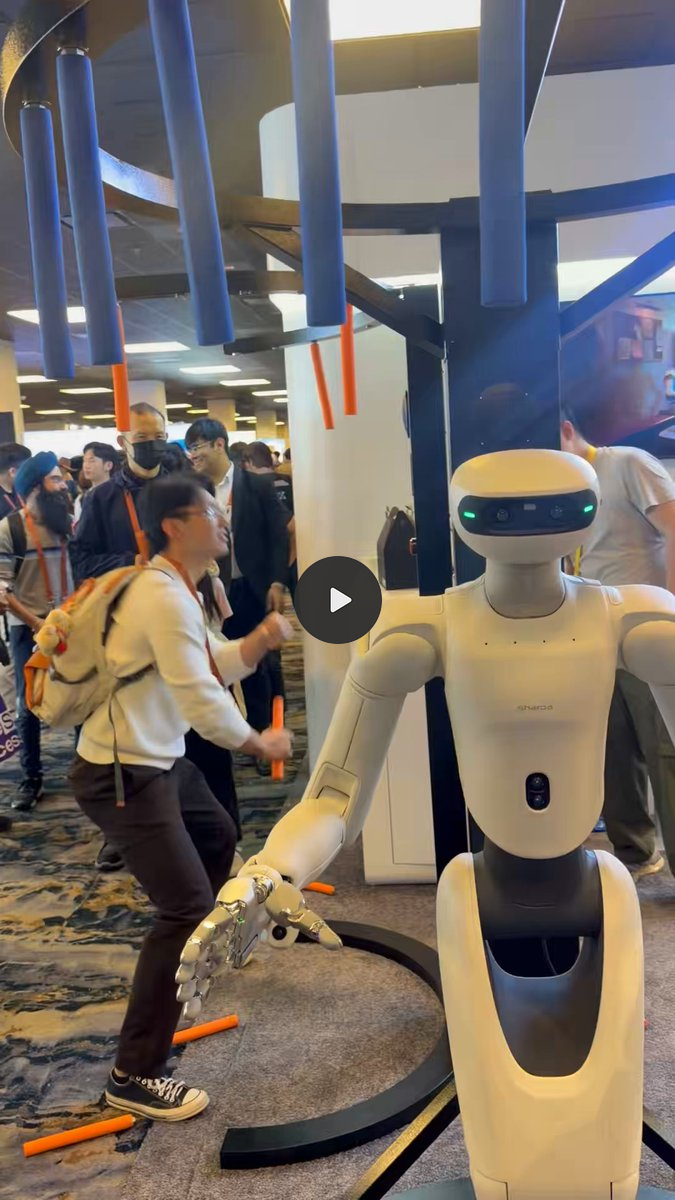
For the hardware folks, the elephant in the room was the Federal Communications Commission (FCC)’s July regulatory update, which placed new robotic quadrupeds, humanoids, and associated parts on an import blacklist. We explored this rule more deeply with the FCC’s Adam Chan last month. One Unitree salesperson told us that the company has managed to obtain licenses for all of their current models, but the FCC rule restricts the sale of future models. We heard the same story again and again from other Chinese vendors, who all expect the FCC rule to have major effects on their business. Still, they’re working hard to ship as many units of the approved robots as they can — after all, the US is their second-biggest market after mainland China.
Apart from selling actual robots and parts, Chinese robotics companies are also targeting foreign markets with robot training data and data-collection hardware. We spoke to Maniformer, founded only in February this year, which has now collected more than one million hours of real-world data. The company, whose CEO is AgiBot cofounder Yao Maoqing 姚卯青, also makes grippers for data collection and headsets that collect egocentric data. They pay people 80 RMB (around US$12) an hour to use their grippers to do housework and submit data through their app. They did note that this is per hour of usable data, not per hour of work — and much of the data collected by contractors is rejected for a laundry list of reasons ranging from doing the task too quickly to using bad form.
This app has gamified promotions to incentivize people toward specific data collection tasks, including feeding pets, organizing items, washing silverware, and sorting packages in a logistics center. I (Lily) jokingly said to Maniformer’s marketing person (in Mandarin) that gig-economy data collection was “the solution to China’s unemployment problem,” but she earnestly and excitedly agreed with me instead of laughing at the absurdity as I had expected.

While monetizing your laundry folding may seem dystopian, it’s less demanding and safer than other gig work like food delivery. But it’s no walk in the park either: the ChinaTalk team tried folding some laundry with grippers, which was more awkward and physically demanding (it tires out your wrists) than it first appeared.
Maniformer is one of many other Chinese companies competing in the red-hot robot data collection space. Other companies take a less distributed direction toward collecting robotics data. One company Aqib spoke with had constructed a facility in Shenzhen with over a hundred “pods.” People in each pod wear special gloves and cameras and accomplish tasks like squeezing balls and manipulating various objects for data that eventually gets sold for $10 to $100.
Robotics data comes in a range of qualities, and even for these companies pouring money into outfitting contractors with grippers and cameras, only a fraction of the data is actually usable. As with AI data, in robotics, it still seems that US firms have the upper hand, producing higher quality data than their Chinese counterparts. For start-ups, however, this isn’t always a good thing. Several American start-ups told us that they can’t afford to buy American robotics data, so they are turning to China.
Regardless of how these companies get their data, though, they all seem to be betting on the good ol’ scaling law.
Other startups in the space were betting on simulations, expecting that physics modeling of robot actions will get good and cheap enough to outcompete. “None of these data collection companies will exist next year,” one entrepreneur said.
Witnessing non-Chinese hardware companies at CoRL was interesting because they can range from glorified assembly companies to true Made In America projects. It is hard to cut through the BS to discover on what end of the spectrum a company is engaging.
Many companies, even if they assemble in the US, purchase all of their sub-components from China due to some combination of availability, performance, or cost. Some components are designed in-house in the United States and then actualized by Chinese Original Design Manufacturers (ODMs), while others are purchased off the shelf from Chinese suppliers. Either way, Chinese firms are the ones getting the production reps in, which creates a virtuous cycle and path dependence as they iterate on their products and processes. One company told us they would prefer to use a European or American supplier because it’s easier to actually visit their facility, but most of the time, non-Chinese suppliers simply have worse products at worse prices with worse customer service and worse turnaround times. If you were a robotics start-up, how could you even attempt to circumvent the route through China?
For all companies, though, motors — and particularly the rare earth permanent magnets inside of them — are the open secret. “We all know who we’re getting them from,” said one company executive, referring to China. It is laughed off and generally understood to be a problem, but no one feels empowered to change it. The West just doesn’t have enough magnet capacity, meaning any homegrown robotics supply chain will inevitably have at least one point of strategic instability.
Will frontier labs solve robotics without roboticists?
OpenAI was supposed to have a booth in CoRL’s exhibition hall, but seemingly abandoned it at the last minute. It was later revealed on November 13 that OpenAI had dissolved their robotics team. OpenAI’s big advance in robotics came instead with the release of Astra, and throughout the conference, speakers and grad students alike joked darkly about the model putting them out of work.
This gloom and doom was only amplified when Anthropic joined the robotics ring. On November 9 — Day 1 of CoRL — Anthropic released Fable 5.2. The company also revealed its new model’s groundbreaking results on RoboDojo, a well-respected benchmark that tests models on their ability to control two robotic arms. At max effort, Fable 5.2 had a RoboDojo success rate of 64.9%. This is far above the success rates of specialist robotics models: the previous RoboDojo record was held by WALL-OSS-1.0-lite, which only scored around 42.6%.
We have no special insights into the timings of these announcements, but one could plausibly read into these announcements a message that frontier labs are sending to the robotics community. Training specialized models for robotics may have been misguided. Frontier models will eat the physical world too.
What, exactly, are the specialized models roboticists have been working on? The leading approach is a class of models called VLAs (vision-language-action models). This begins with general-purpose AI models, which can take in images and text and output text. Roboticists fine-tune them to output actions: gripper commands, joint angles, where the robot’s hand should end up, etc. The fine-tuning process is where researchers diverge in strategy. Recordings of human teleoperators form the bulk of the data used. On top, some researchers explore learning from motion capture, first-person videos, and simulations. More recently, reinforcement learning post-training has become a fast-moving area, as it promises to let robots improve through their own trial and error. The goal is to turn a prompt like “put the red ball in the blue bin” into action directly, without engineers hand-coding the specific behavior.
Fable (and OpenAI’s Astra, which also demonstrated impressive robotics performances) does not output action, because it was not fine-tuned to be a VLA. Instead, these general-purpose models are closer to programmers. They control robots the same way they control computers: through code and tool calls. When faced with a prompt like “put the red ball in the blue bin,” Fable and Astra issue step-by-step commands while watching the camera. Anthropic claims Fable 5.2 successfully improved control “even for robotics tasks on which it has never explicitly been trained.” But other researchers think frontier models’ robotics abilities did not come out of the ether. Aiden Swann, a fellow at the interpretability research firm Goodfire, argued on X that he found evidence of Astra training on robotics data:

We also heard from multiple researchers at the conference that the frontier multi-modal LLMs got better at spatial reasoning, and thus robotics, in part through reinforcement learning on computer aided design (CAD) and code-render-inspect loops inside Blender and physics simulators. The same capability that lets you one-shot a 3D print design or a 3D videogame is making a bunch of grad students very nervous.
The trendlines indicate that frontier labs will cannibalize VLAs, but some speakers at CoRL had a more optimistic view (which may be serving a spiritual role as copium). While frontier models accomplish robotics tasks well, they often accomplish them slowly, limiting their applicability in the real world. The future may involve frontier models communicating with VLAs and then hardware in quicker loops, such that each has its place in a robotics system. The other route may simply be that frontier models will learn to quickly direct individual components of the robot and receive feedback from the physical world, especially as models increasingly become distilled and chips get increasingly better bandwidth.
If VLAs were the wrong route, where does that leave roboticists? Another school of thought says that instead of just modeling actions, robots must also model the world they will act in. World models are trained on large volumes of video data with one goal: to predict what happens next when one action takes place. If there is a cup of tea on a table and a person knocks it over, tea should spill onto the floor and the cup may break. The goal is for world models to develop abstract internal representations of physical phenomena — something like intuitive physics. Based in part on world models research, some roboticists are working on world action models (WAMs), which predict future frames alongside robot actions.
At CoRL, world-model champion Fei-Fei Li presented Atlas, the newest world model released by her startup World Labs. (World Labs was recently acquired by AMD for US$8.2 billion). From just 25 photos taken at ground level, Atlas was able to generate a convincing aerial video of Stanford University’s Main Quad. The hope is that work like this will help robots learn in diverse simulated environments and depend less on real-world data. According to one skeptical researcher, “It’s no coincidence she sold her startup the same week Astra’s robotics results came out. Smart woman, but the frontier labs are gonna cook world models. Good for her to get out at the top.”
Why do robots still suck?
Two days into our robot adventure, we started fantasizing about a drinking game where we take a shot every time “laundry” was mentioned. For roboticists, the home is the ultimate prize. Our residences are diverse, chaotic environments where many delicate tasks (cooking, sweeping, stacking) take place. The rewards could be immense (imagine how much people would pay to never fold laundry again!), but the potential challenges — like having a 70-kilogram humanoid trip and fall on a toddler — are also overwhelming.
Back in the exhibition hall, Dyna stole the show with a humanoid that, with moderate deftness, moved hand towels from a front-load washer to a dryer. (Jordan: my two-year-old daughter, who watched the demonstration on FaceTime, was a huge fan. Their booth was right next to Unitree’s, whose salesperson insisted during the call that “our robots can wash clothes too!” When I brought her over to see Unitree’s robots, she was unamused and demanded to see the Dyna again.)

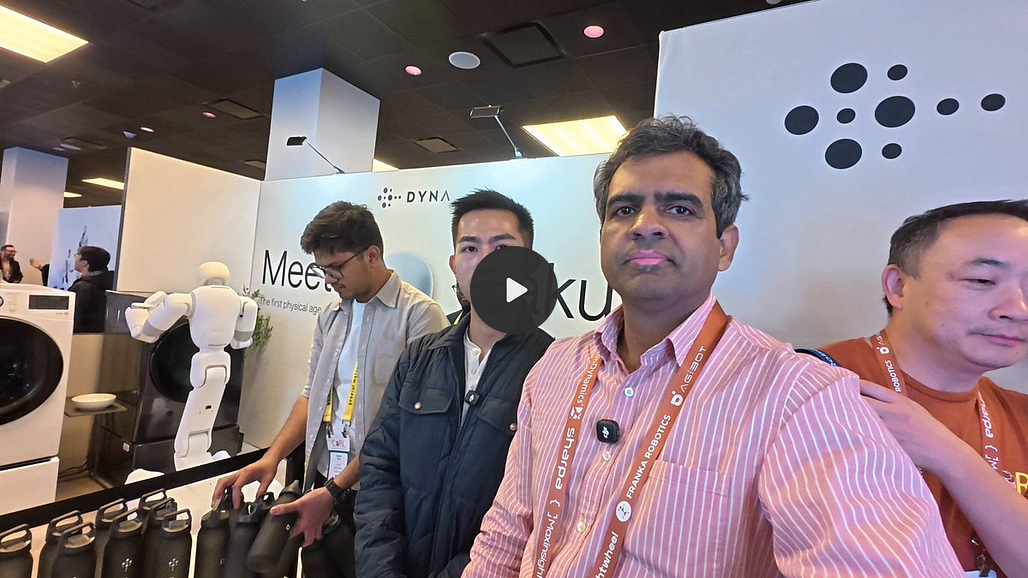
Watching the pearly-white machine-man zoom between the two appliances was delightful, but also puzzling. There is something weirdly redundant about having such a marvel of engineering do something so mundane. Shouldn’t we just make different laundry machines instead? If we are to delegate tasks to powerful machines, should we still design the world around the limits of humans? Or would that be pushing humans out of a necessary loop, as the woman near the riverbank warned us?
Not having answers to these questions may, in part, be why robots still suck. Everyone wants robots to do different things. “Generalization” — being able to do things without explicit instruction — is a badly-defined objective, one that not even AI models operating purely in the digital realm have achieved. How “generalized” is a model that solves Millennium Problems but can’t draw a realistic pelican? Indeed, how “generalized” is each of us, who learns some things faster and others more slowly?
With generalization comes the question of humanoids. CoRL was awash with humanoid robots. Aside from two drone delivery companies, every booth sported either a full humanoid or a robotic hand. When we pressed them with questions like, “Why humanoids?” (or, “Why five fingers?”), we were primarily met with two answers. The first, and by far the most common, was that human spaces are more easily navigated by human-shaped robots. This maybe makes sense in the home, but some companies even defended this for industrial spaces. I (Quinn) pushed back on this a bit. Industrial spaces are famously not great spaces for humans — this is why we have OSHA. This is a fundamental question for the field. We are designing robots to fit human spaces, but we are not designing human spaces to fit robots.
Many factories today are largely automated without generalized robots, taking advantage of simple robots that repeat the same task over and over. Companies across the world, particularly in China, have operated dark factories for years, with the task complexity that can be automated without a human (or a generalized robot) climbing steadily. Yet somehow generalized robot companies still feel they have an industrial market. The logic, as one GM engineer told us, is that building a new autonomous factory or autonomizing a legacy one requires large capex — they’ve had to shut down two of their plants for multiple years to transition them. A humanoid can come into legacy plants immediately, without any retrofitting of the factory. Though of course the current “generalized” robots are still slower, more expensive, and take longer to train than human employees.
For regular consumers, autonomous driving is the robotics use case closest to our daily lives at present. The Tesla booth at CoRL offered two free Robotaxi rides for every conference attendee, so your humble ChinaTalk team happily took advantage of Elon’s fleet for a few days during our Austin travels. At night, the Cybercab’s paint bears an uncanny resemblance to Pantone 448 C, the color deemed “least attractive” to human beings by researchers designing cigarette packaging. There were no side or rearview mirrors, which delighted some of us but repelled the rest. During one ride, our Robotaxi crossed double-yellow lines into the opposing lane to pass a pulled-over gas truck — a slightly horrifying maneuver. Our favorite feature was being able to connect our own music streaming, as the Waymo-Ubers in Austin limited us to iHeartMedia muzak.

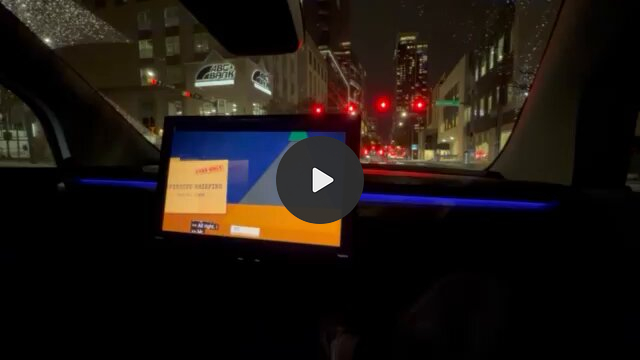
We did, however, learn about Elon’s hatred for LiDAR, the technology that uses laser pulses to measure distances. No Tesla car, fully autonomous or otherwise, uses LiDAR, instead relying solely on camera-based systems. Elon claims LiDAR is a crutch and that humans rely entirely on “neural nets and optical sensors” (with just two eyes serving as cameras), so robot cars should be able to do this also. He seems to have no problem using 360 vision, though, which I personally do not have. The real motivation behind this reasoning seems to stem from the higher price of LiDAR. As one engineer we spoke to about LiDAR said, “Do you want to make money, or do you want to never kill anybody?” (“Can’t you do both?” we asked in response, to which this person replied, “Yeah, that’s Waymo.”)
A brief soapbox moment on self-driving cars from Quinn:
I took my first through sixth self-driving car rides at this conference. My first takeaway is that the technology is there — almost completely. While I’m sure Luddites like me, who find something distinctly enjoyable about getting behind the wheel or chatting it up with my Uber driver, will limit diffusion for a while, I’m confident that it will spread much wider and deeper. When we took the Cybercabs, however, the instinct was not to look out the windows in awe of the human ingenuity propelling us forward and gaze in appreciation at the city passing around us. In a way that driving or riding in a human-driven car does not, the self-driving cars felt isolating, forming a barrier between ourselves and the outside world. After a few moments of initial shock at the lack of a steering wheel, the experience felt normal in the same way scrolling through endless short videos that an algorithm has curated for you feels normal. Indeed, riding in the autonomous cars seemed almost to demand that we retreat even further into that other ever-isolating device. Once we entered the cars and set the AC to exactly the level that we wanted, we retreated into our phones, checking messages, emails, and the Jensen news…
...Someday I’ll write the article on why America can build self-driving cars but not public transportation.
Oh, and if arms (manipulation) and legs (locomotion) are not enough automation for you, some companies are bravely venturing into the face space:
Why do you keep thinking of China as an enemy instead of an opportunity to collaborate for mutual social benefit?